
IMUGA portal help
Maldives Entry Rules and Customs Restrictions
A practical guide to arriving in Maldives: passport validity, onward ticket and funds at the counter, then the customs rules that actually catch travellers out at Velana.
Your Traveller Declaration gets you through the first desk. What decides the rest of your arrival is your passport, your booking, your onward ticket and, above all, what is inside your bags. Maldives is a Muslim country with customs rules that surprise first-time visitors, and Maldives Customs enforces them on the belt at Velana International.
Short answer: Bring a passport valid for at least six months, a confirmed booking and an onward ticket, and expect a no-cost 30-day visa on arrival. Then leave the alcohol, pork, pornography and religious idols at home — they are prohibited imports, and alcohol is held until you fly out.
What the immigration officer looks at beyond the declaration
The declaration is a data submission. The officer at the counter is doing something different: forming a judgement about whether you are a genuine short-term visitor. Four things support that judgement, and they are checked in roughly this order.
- A passport with at least six months of validity from the date of arrival, with blank pages for the stamp. Six months is the working rule, and a passport with five months and three weeks is a real risk of being turned around at check-in before you ever reach Maldives.
- A confirmed accommodation booking. Not a screenshot of a search result — a booking with your name, the property name, and dates that cover your stay. Resorts, hotels, guesthouses on local islands and liveaboards all count.
- A return or onward ticket dated within your permitted stay. This is checked more often than travellers expect, and it is the single most common reason a smooth arrival becomes a slow one.
- Sufficient funds for the trip. In practice this is rarely asked of someone with a prepaid resort booking, and asked more often of a traveller with an open itinerary and a cheap guesthouse.
The officer may also ask conversational questions: how long you are staying, which island, whether you have been before. These are not traps. They are consistency checks against what you already wrote.
In short: Six months of passport validity, a named booking, an onward ticket and plausible funds. Everything else follows from those four.
The no-cost 30-day visa on arrival, briefly
Most nationalities receive a no-cost 30-day visa on arrival in Maldives, issued at the counter, with no application and no fee. The Traveller Declaration is not a visa and does not replace it; the two are separate things that happen to be part of the same arrival.
The word to hold on to is conditional. The visa is granted on the basis of the four items above being satisfied. It is not automatic in the sense of being unconditional — it is automatic in the sense that if your paperwork is in order, nobody asks you to apply for anything.
Extensions beyond thirty days exist and are handled locally by immigration, with their own process and fees. If you are staying longer, or you hold a work permit or residence status, the rules diverge from tourist arrivals in ways we cover in our guide for residents and work permit holders.
In short: A no-cost 30-day visa on arrival for most passports, conditional on documents, and entirely separate from the declaration.
Why Maldives customs is stricter than you expect
Here is the part that catches people. Maldives is an Islamic country and its import rules follow from that, not from a generic tourism-friendly template. A traveller who has been through a dozen beach destinations without opening a bag can arrive assuming the same, and be wrong.
Two features make the system distinctive:
- The prohibitions are about category, not quantity. One bottle of wine is not a small amount of alcohol; it is alcohol. The same logic applies to pork products.
- The resort experience contradicts the border rules. Resorts serve alcohol freely under licence, which leads travellers to conclude that alcohol is simply fine in Maldives. At the border it is not.
Screening on arrival at Velana is routine and reasonably thorough. Bags go through scanners, and a bottle shape in a suitcase is not subtle.
Worth knowing: Duty-free bought at your transit airport is the classic trap. A bottle purchased in Dubai or Doha and carried in hand luggage is still an alcohol import when you land in Malé, and it will be taken from you.
In short: The rules are religious and cultural in origin, category-based rather than quantity-based, and actively enforced at the airport.
Prohibited items: what you must not bring at all
These categories are prohibited imports. Bringing them is not a formality to be resolved with a declaration form.
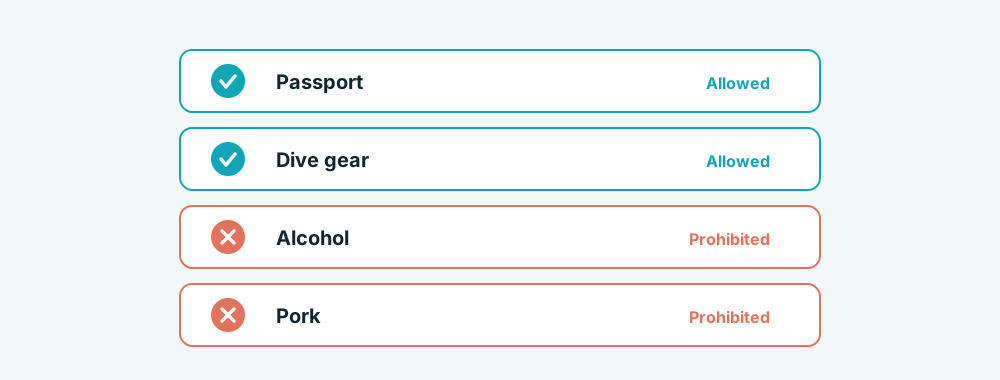
- Alcohol in any form and any quantity, including duty-free purchases and miniatures.
- Pork and pork products, including cured meats, sausages and pork-derived snacks.
- Pornographic material, in print or on a device.
- Religious idols and materials for non-Islamic religious practice. Personal items for your own private use are treated with more nuance than a box of statues, but the category is restricted and importing quantities is not permitted.
- Narcotics and illegal drugs, which are treated extremely severely. This is the one item on the list where the consequences are measured in years, not inconvenience.
- Weapons, ammunition and explosives, plus items that look like them.
- Spearguns and spearfishing equipment, because spearfishing is prohibited in Maldivian waters.
- Live animals and certain animal or plant products without prior authorisation.
The nuance around religious items deserves one line of good faith: a personal cross or a small object of private devotion is not the target of the rule. The rule is aimed at importing religious materials into the country. Keep personal items personal.
In short: Alcohol, pork, pornography, religious imports, drugs, weapons and spearguns are prohibited categories, with drugs in a class of severity of their own.
The alcohol rule, in practice
This is the single most useful thing to understand about Maldivian customs, because the outcome is not what most travellers fear.
If alcohol is found in your luggage on arrival, it is normally held in bond at the airport and returned to you when you depart. You are given a receipt. On the way out you present it, collect your bottle, and carry it onward. It is a delay and a queue, not a penalty — provided you have not tried to conceal it.
Two consequences follow. First, there is no point smuggling: the honest outcome is a receipt, and the dishonest outcome is a problem. Second, there is not much point bringing it either, since you cannot drink it during your trip.
Meanwhile, resorts and licensed hotels serve alcohol legally under their own licences, and liveaboards generally do too. Alcohol is not absent from a Maldives holiday. What is absent is your ability to import your own — and on local islands, which are inhabited communities rather than licensed resorts, alcohol is not served at all. That distinction matters enormously if you are staying in a guesthouse, and it is one of the practical differences we set out in the guide to resorts and liveaboards.
In short: Alcohol is held on arrival and returned on departure. Resorts serve it under licence; local islands do not.
Restricted items: allowed with conditions
Restricted is a different category from prohibited. These items can come in, but with a permit, a limit or a declaration.
Drones. Subject to authorisation. Maldives regulates unmanned aircraft, and the airport is not the place to discover that. Beyond the national rules, most resorts have their own policy on filming, driven by guest privacy, and a resort can refuse to let you fly on their island regardless of any permit. Sort out authorisation before you travel, and ask your resort in writing.
Tobacco. A limited personal allowance applies, as in most countries. Amounts and duty rules change, so check the current figures officially rather than relying on what a forum said last year. Vaping products have been subject to their own restrictions in recent years and deserve a separate check.
Diving equipment. Personal gear is completely normal and arrives with every second passenger. It is not restricted. What is prohibited is the spearfishing subset — spearguns, Hawaiian slings and similar. Bring your regulator, computer and camera without concern; leave the speargun.
Pets. Importing animals requires prior authorisation and health documentation, and this is not a same-day process. Note also that most resorts do not accept pets at all, so the practical obstacle usually arrives before the regulatory one.
Medication. Personal quantities in original packaging with a prescription are ordinary travel. Controlled categories need checking in advance, and the documentation that travels best is the original pharmacy label plus a doctor's letter.
Commercial quantities of anything. Goods that look like stock rather than luggage change category and become an import.
In short: Drones and pets need authorisation, tobacco has a personal allowance, diving gear is fine, spearguns are not.
Item-by-item reference table
| Item | Status | Notes |
|---|---|---|
| Alcohol (any quantity) | Prohibited | Held in bond on arrival, returned on departure |
| Duty-free bought in transit | Prohibited | Same rule as any alcohol; the receipt does not help |
| Pork and pork products | Prohibited | Includes cured meats and pork-derived snacks |
| Pornographic material | Prohibited | Applies to devices as well as print |
| Religious idols, materials for import | Prohibited | Personal devotional items treated with more nuance |
| Narcotics and illegal drugs | Prohibited | Severe penalties; no tolerance threshold |
| Weapons and ammunition | Prohibited | Includes replicas and lookalikes |
| Spearguns, spearfishing gear | Prohibited | Spearfishing is banned in Maldivian waters |
| Drones | Restricted | Prior authorisation plus resort permission |
| Tobacco and cigarettes | Restricted | Personal allowance; verify current limits officially |
| Vaping devices and liquids | Restricted | Rules have changed recently; check before packing |
| Pets and live animals | Restricted | Prior authorisation; most resorts do not accept them |
| Prescription medication | Restricted | Original packaging plus prescription; verify controlled classes |
| Diving equipment | Allowed | Standard personal gear, no permit needed |
| Fishing rods (line fishing) | Allowed | Excursions are common; spearfishing remains banned |
| Drone-no-cost cameras and GoPros | Allowed | Respect privacy on inhabited local islands |
| Non-pork food for personal use | Allowed | Commercial quantities change the category |
| Modest beachwear for local islands | Allowed | Bikinis are for resorts and designated beaches only |
In short: Most luggage is entirely unremarkable. The failures cluster in six or seven predictable items.
Local islands, resorts and the two sets of rules
Understanding Maldivian customs is easier once you see that the country runs two parallel environments for visitors.
Resort islands are private, licensed and effectively self-contained. Alcohol is served, swimwear is unremarkable, and the atmosphere is that of an international resort anywhere.
Local islands are inhabited Maldivian communities where residents live under local norms. No alcohol is served. Modest dress is expected away from any designated bikini beach. Behaviour that is invisible at a resort is conspicuous here.
Neither is a trap, and guesthouse tourism on local islands is a genuinely rewarding way to see the country. But packing for one is not packing for the other, and the customs rules at the border are written for the country, not for the resort.
Worth knowing: If your trip mixes both — a few nights in a Malé or Hulhumalé hotel, then a guesthouse, then a resort — pack for the strictest environment and adapt upward, not the other way round.
In short: Resorts are licensed and permissive; local islands follow community norms. The border rules follow the country.
What actually happens at the customs channel
The mechanics at Velana are undramatic. After immigration you collect your bags and pass through customs, where luggage goes through a scanner. Most travellers walk through in under a minute.
If something is flagged:
- You are asked to open the bag. Do it calmly. Being asked is routine.
- The item is identified and categorised. Prohibited, restricted or fine.
- Alcohol is bonded, and you are given a receipt to reclaim it on departure.
- A restricted item without authorisation may be held or refused entry.
- You continue to your transfer. For a seaplane, the desk is in a separate terminal and the schedule is daylight-only, so a customs delay can genuinely cost you a same-day transfer.
That last point is the practical argument for packing correctly. The cost of a customs stop is rarely a fine — it is missing the last seaplane and spending an unplanned night in Malé. If your itinerary includes a same-day domestic connection, our notes on transit and connecting flights explain how little slack there usually is.
In short: Customs is quick unless something is flagged, and the real cost of a delay is a missed seaplane rather than a penalty.
If you arrive by sea instead of by air
The same prohibitions apply to a yacht or a cruise ship, but the clearance process is different: vessels clear at designated ports rather than at an airport channel, and the ship's own stores are handled as part of that clearance rather than as personal luggage.
For a private yacht, that means alcohol on board is a matter for the vessel's clearance and the agent handling it, not something you carry through a scanner. For a cruise passenger, the practical rules ashore are the ones that matter: the same restrictions on what you bring off the ship, and the same distinction between resort islands and inhabited communities. We cover the process in the guide to arriving by cruise or yacht.
In short: Prohibitions are identical by sea, but clearance happens at the port through the vessel rather than at an airport belt.
Costs that appear after the border
Clearing customs is not the last financial step of arriving. Two charges are worth knowing about in advance so they do not feel like a surprise on your final bill.
- Green tax, charged per person per night by your accommodation.
- TGST, the goods and services tax applied to tourism services.
Airport charges are normally included in the price of your air ticket rather than collected separately at the terminal. We break the whole picture down in the guide to green tax and airport fees.
In short: Expect green tax per night and TGST on tourism services; airport charges are already inside your ticket.
Key points
- Immigration checks six months of passport validity, a confirmed booking, an onward ticket and funds.
- Most nationalities get a no-cost 30-day visa on arrival, conditional on those documents.
- Alcohol, pork, pornography, religious imports, drugs, weapons and spearguns are prohibited.
- Alcohol found on arrival is held in bond and returned when you leave the country.
- Drones and pets need prior authorisation; tobacco has a personal allowance; diving gear is fine.
- Resorts serve alcohol under licence; inhabited local islands do not.
FAQ on Maldives entry and customs
Can I bring a bottle of wine as a gift?
No. Alcohol is a prohibited import in any quantity. It will be held at the airport and returned to you on departure, which means the gift arrives at your home, not at your resort.
What happens to duty-free I bought in Doha or Dubai?
It is treated as any other alcohol import. Expect it to be bonded on arrival and returned when you fly out. Buying it on the way home instead is the simpler plan.
Is there really alcohol at the resorts?
Yes. Resorts and licensed hotels serve alcohol legally under their own licences, and so do most liveaboards. The restriction is on importing it yourself, not on drinking in licensed venues.
Can I bring my drone?
Only with prior authorisation, and separately with your resort's permission. Many properties restrict drone filming for guest privacy regardless of what national permits you hold.
Are diving equipment and spearguns treated the same?
No. Ordinary diving gear is completely normal luggage. Spearguns and spearfishing equipment are prohibited, because spearfishing is banned in Maldivian waters.
How much tobacco can I bring?
A limited personal allowance applies. The exact figures and duty treatment change, so confirm the current limits on the official channels rather than trusting an old forum thread.
Do I really need an onward ticket?
Yes, and it is checked more often than travellers expect. A return or onward ticket within your permitted stay is one of the conditions for the visa on arrival.
Can I bring my dog?
Importing animals requires prior authorisation and health documentation, and it is not a quick process. In practice most resorts do not accept pets at all, so check with your accommodation first.
Is my passport valid if it expires in five months?
Treat six months from arrival as the working requirement. With less, you risk being refused at check-in in your departure city, long before Maldives has a view on it.
Can I wear a bikini outside the resort?
On resort islands and designated bikini beaches, yes. On inhabited local islands, modest dress is expected, since these are residential communities rather than tourist facilities.
Last updated: July 2026. Immigration rules change; always confirm current requirements on the official Maldives Immigration portal before travelling.